



The Most Iconic Designer Lamps: Arco, Tolomeo and Other Masterpieces at Montenero 53
Nothing makes a home feel elegant quite like a designer lamp. Light plays a fundamental role in defining the beauty and function of an interior, while also serving as a valuable decorative element.
The celebrated designer Ingo Maurer argued that light is not merely a functional element, but an almost spiritual dimension, capable of influencing our wellbeing and the atmosphere of the spaces we inhabit.
But what makes a lamp a designer piece, and which iconic examples have earned their place in the history of interiors?
What distinguishes a designer lamp?
A lamp becomes a designer piece when it achieves a perfect balance between aesthetics and functionality. It is an object with the important role of enriching its surroundings, giving them character and personality.
Elegant forms and practical needs work in perfect harmony, in a process where every detail is carefully considered to create something practical but, above all, captivating.
The choice of materials is also essential, because this piece of furniture, and of art, must offer durability and stand the test of time. Glass, metal and polycarbonate are therefore carefully selected to ensure beauty and strength.
Designer lamps: when lighting becomes iconic
Designer lamps are much more than simple furnishing objects: each has a rich history, a complex philosophy, and a stylistic identity that make them unique. Some embody these qualities so completely that they have become true icons.
ARCO – Flos

One of the earliest examples is Arco, designed in 1962 by the brothers Achille and Pier Giacomo Castiglioni for Flos. This floor lamp answered the need for a light suspended over a table without drilling into the ceiling. Its Carrara marble base includes an ingenious practical detail: a hole into which a handle can be inserted to move it easily.
Costanza – Luceplan

Another example of minimalist elegance is Costanza, created by Paolo Rizzatto for Luceplan in 1986. With its polycarbonate shade and lightweight metal structure, this lamp represents the archetypal pared-back floor lamp. Its
form is simple and clean, allowing it to suit any setting, whether classic or contemporary.
Eclisse – Artemide

In a completely different style, we find Eclisse. Designed by Vico Magistretti for Artemide in 1965, it allows the light to be partially or completely screened by rotating the inner dome, creating a fascinating, poetic interplay of light and shade that echoes its name.
Atollo – OLuce

Atollo is an example of pure geometry, designed by Vico Magistretti for Oluce in 1977. It combines simple forms such as the cylinder, cone and hemisphere, establishing itself as a true symbol of formal precision and elegance.
Falkland – Danese

The creativity of Bruno Munari is powerfully expressed in his lamp Falkland, an extraordinary object created in 1964 for Danese. Falkland consists of a tube of white elasticated fabric and metal rings, giving it a flexible, dynamic form.
Acrilica – OLuce

Acrilica by Joe Colombo, created in 1962 for Oluce, is another visionary example of design. Light passes through the transparent methacrylate and spreads in surprising ways, creating a mesmerising effect that makes the lamp almost ethereal.
Zettel’z – Ingo Maurer

Zettel’z by Ingo Maurer is a chandelier whose sheets of Japanese paper, suspended from steel wires, can be personalised with messages or drawings. It turns lighting into an interactive, personal art form.
Bourgie – Kartell

Among the more playful models is Bourgie by Ferruccio Laviani for Kartell, a table lamp that combines baroque style and modern materials, available in a wide range of colours and finishes.
Fontana – Fontana Arte

Fontana, designed by Max Ingrand, is made entirely of glass, casting soft light from both its base and shade. A classic of lighting design, it perfectly demonstrates how functionality and beauty can come together in a single object.
Parentesi – Flos

Achille Castiglioni and Pio Manzù went on to create Parentesi: a lamp that moves along a steel cable fixed between ceiling and floor, making it incredibly versatile and practical.
Caboche – Foscarini

True elegance also finds expression in Caboche by Patricia Urquiola. Made up of dozens of polymethacrylate spheres, this lamp casts light reminiscent of a precious jewel.
Hope – Luceplan

With Hope,, Francisco Gomez Paz and Paolo Rizzatto demonstrated that innovation is still possible. Its polycarbonate lenses multiply the light, creating a luminous effect that recalls classic chandeliers, but with a modern touch.
Tolomeo – Artemide
The lamp Tolomeo by Michele De Lucchi and Giancarlo Fassina has a versatility and simplicity that make it perfect for any space, especially workplaces, where efficiency is essential.
Titania – Luceplan

Titania, created by Paolo Rizzatto and Alberto Meda in the ’80s, is a bold, experimental lamp that conceals its light source behind aluminium ribs, colouring the light with interchangeable filters.
TeTaTeT – Davide Groppi

Finally, TeTaTeT by Davide Groppi is one of the first cordless lamps, bringing together the innovation of an integrated battery and a delicate design that evokes the romantic atmosphere of a candle.
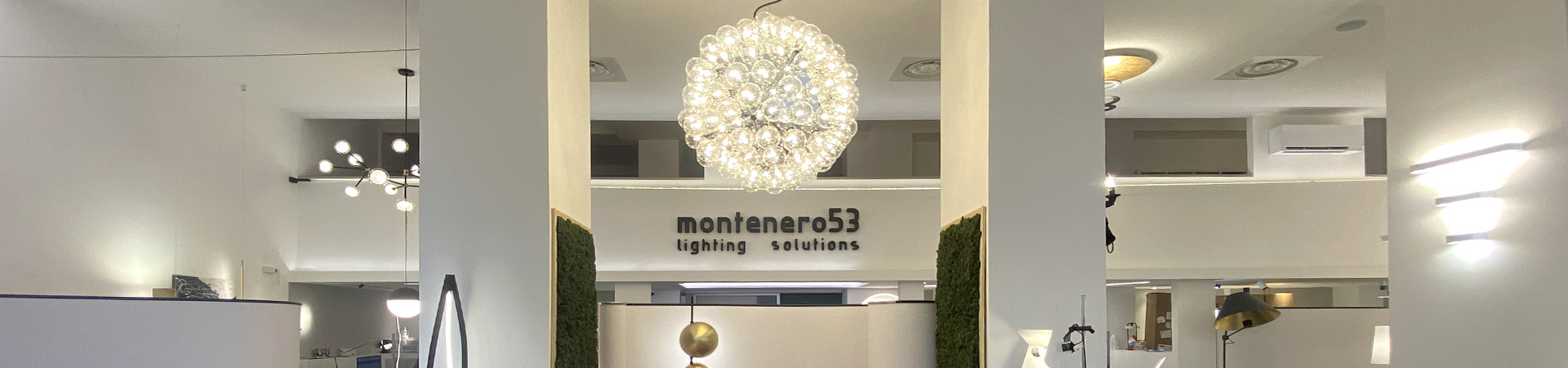
Even the most iconic designer lamps must be placed in the right position, in harmony with their surroundings, to express their beauty and functionality fully. Careful lighting design is essential to enhance the atmosphere and meet the functional needs of every space, whether residential, commercial or professional. MONTENERO 53 offers a complete lighting consultancy and design service, supporting architects, interior designers and private clients in choosing the most suitable solutions.
Contact us to book an appointment or a personalised consultation, and let’s transform every space together with the perfect light.